
The Republic of the Union of Myanmar
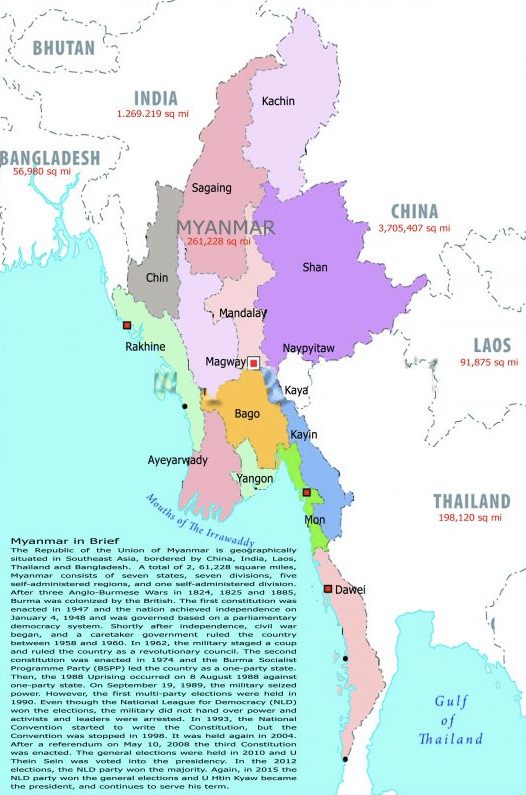
Burma (Myanmar) has a total area of 676,578 square kilometers (261,228 square miles) and is the second-largest country in Southeast Asia. It shares borders with Bangladesh and India to the west and northwest, the People’s Republic of China to the north and northeast, and Laos and Thailand to the east and southeast. To the south and southwest lies the Andaman Sea and the Bay of Bengal. The country is home to a wide range of ethnic groups, each with distinct cultures, languages, histories, and identities that together form a diverse society.
Since 1824, the British invaded three Anglo-Burma wars against Burma. By 1886, the country had fallen under British rule. Burma remained a British colony until 1942, and the territorial boundaries of modern Burma were also drawn and established by the British.
In 1942, the British retreated from Burma, after which the country came under Japanese occupation. From 1942 to 1945, Burma was under rule by Japan, but in 1945 it once again returned to British control. On January 4, 1948, Burma gained complete independence and was freed from colonial rule.
From 1948 to 1958, Burma was governed under a parliamentary democratic system led by Prime Minister U Nu. Between 1958 and 1960, a caretaker government led by General Ne Win temporarily seized control of state power. In April 1960, a general election was held again, and the state power was transferred to the Union Party (Pa Hta Sa), led by U Nu, who won the election. However, on March 2, 1962, the military, led by General Ne Win, seized state power from Prime Minister U Nu through a coup d’état. On April 30 of the same year, the military-controlled Burma Socialist Programme Party announced the Burmese Way to Socialism and all other political parties were abolished.
The country was then ruled by the military. On July 4, 1962, the ‘Burmese Way to Socialism’ was formally established. In January 1974, the 1947 Constitution was abolished and replaced by the 1974 Constitution of the Socialist Republic of the Union of Burma, which was approved through a referendum. After 1974, the Socialist Programme Party ruled the country.
In 1988, a nationwide popular uprising, widely known as the 8888 Democratic Revolution, emerged across the country and succeeded in forcing three successive presidents to step down. Nevertheless, on September 18, 1988, the military led by General Saw Maung and Lieutenant General Than Shwe once again seized state power in a military coup and formed the State Law and Order Restoration Council (SLORC) to govern the country. On November 15, 1997, SLORC was reformed into the State Peace and Development Council (SPDC), which continued ruling Burma until 2010.
From 1993 to 2008, the military drafted a constitution that was designed to protect its own political interests. The 2008 Constitution was imposed through a heavily controlled and widely criticized referendum conducted under military rule. Under this constitution, a general election was held in 2010, and in 2011 a quasi-civilian government led by President Thein Sein came to power.
In the 2015 multi-party general election, the National League for Democracy (NLD), led by Aung San Suu Kyi, won a landslide victory nationwide and formed a government that ruled the country for the next five years.
After the NLD won the 2020 general election once again, the military, led by Min Aung Hlaing, alleged that electoral fraud had occurred and illegally seized state power on the morning of February 1, 2021.
At the same time, the military arrested many political leaders, including State Counsellor Aung San Suu Kyi and President Win Myint, as well as elected members of parliament and numerous activists. In February 2021, elected parliamentarians from the 2020 election established the Committee Representing Pyidaungsu Hluttaw (CRPH). Based on the results of the 2020 election, the CRPH later formed the National Unity Government (NUG) in opposition to the military regime.
The National Unity Government (NUG) is made up of:
- Win Myint – President (detained)
- Aung San Suu Kyi – State Counsellor (imprisonment)
- Duwa Lashi La – Acting President
- Mahn Winn Khaing Thann – Prime Minister
Additionally, students, young people, education staff, healthcare workers, civil servants, and many civilians, who rejected the military coup, peacefully protested across the country. Many civil servants who protested the coup left their government jobs in what became internationally recognized as the Civil Disobedience Movement (CDM). However, peaceful protests were violently suppressed, with protesters arrested and killed by the military. Hence, many young people across the country later formed the People’s Defence Forces (PDF) and continued to resist the military regime through armed revolution.
Up to the present day, the military junta has continued to commit grave and systematic human rights abuses, including arbitrary arrests, mass imprisonment, torture, and extrajudicial killings; brutally suppressing opposition to its coup and killing thousands of innocent civilians.